Saturday, April 26, 2025

16. Gypsy Queen 1986–1990 (Miami/Loop UK)

Tour promotional flyer for the never-released “Out of Control” album (left); Photo: Rock of Ages Music/eBay. Talent agency promotional photo (right); Photo: Last FM.


Sure, the major labels were sniffing around South Florida in the mid-’80s, taking notice of the packed crowds for Cryer, Roxx Gang (down from Tampa/St. Pete), Tuff Luck, and Young Turk; also slugging it out on the local club scene — and vying for the “hottest band in Miami” tag against a then very hot Young Turk — was the co-lead singing twins Pamela and Paula Mattioli of Gypsy Queen.

Unfortunately, even with respected sideman Peter “Mars” Cowling from the Pat Travers Band (of the classic rock hits “Snortin’ Whiskey” and “Boom Boom (Out Go the Lights)”) on bass and songwriting chores, along with the golden ear of producer Jack Douglas (he’s back) behind the boards: a major label contract elevating the sisters to his successes with Aerosmith, Blue Öyster Cult, and Cheap Trick, wasn’t forthcoming. Yes, even with the added press buzz of the Mattioli sisters’ infamous, 1985 “nude spread” in the pages of Playboy that gave the rock twins U.S national press coverage (more on that, later).

Pam & Paula at the Button South in
Hallendale, Florida, December 1988.

Gypsy Queen at the Button South, January 1989.


While the “New Wave of British Heavy Metal” (also known as NWoBHM, which began in 1979; birthed the likes of Def Leppard, Iron Maiden, and Saxon) waned by 1985, Europe still offered loyal hard rock audiences for Gypsy Queen’s brand of melodic metal.

So, armed with their eponymous, Douglas-produced debut (Loop, their British label, teased it with the three-song Snarls ‘N Stripes EP; yes; the girls posed with tigers; not “cheetahs”; more on that confusion, later), the Mattioli sisters headed across the pond — where they quickly became perpetual poster girls for the country’s popular metal magazines Kerrang! and Metal Hammer — alongside the leather jumpsuit-clad, U.K “rock royalty” that was Suzi Quatro.

Now, while rockers in France couldn’t get enough of the sisters or Suzi Q (and American film comedian Jerry Lewis), the British rock press — even when a couple of Yank chicks with guitars take the 1987 Reading Festival by storm — had no problem taking Gypsy Queen to task with outright cruel reviews. (Just ask the guys from Def Leppard about their homeland reviews; the same press predicted Metallica’s favorite band, Diamond Head, would dominate the world and Joe Elliot and company would disappear.) The whole “eye-candy” marketing ploy intended to make them stars, resulted in Gypsy Queen unable to prove themselves as a “serious” rock act — this from a landscape producing the not-so-serious, “men-behaving-badly” NWoBHM outfits of Bathory, King Diamond, and Venom; besides: the Brits already had their own hard rocking female outfits in the scrappier Rock Goddess and Girlschool, so said the British rock press.


Perhaps if the Mattioli sisters headed to the U.K, earlier — as did Canada’s April Wine, Switzerland’s Krokus, and New York’s Mark Manigold’s Touch — to take advantage of the NWoBHM at its height (Touch and April Wine appeared at the inaugural “Monsters of Rock” festival at Castle Donington racetrack in 1980; each appeared on the subsequent Polydor-charting accompanying album), critical and chart success would have been assured.

Instead — with shades of Tampa’s Shadowland — the Mattioli sisters blamed Jack Douglas for making the band sound “too polished,” not typical of their live shows. In Jack’s defense: He had his misses, too: the never-got-a-gold record Bux, Moxy, New York Dolls, Rough Cutt, and Starz (and not everyone can have a fluke MTV-hit like Zebra).

So, Jack’s gone . . . and so is the rest of the band.

Remaining in Europe, the all-new Gypsy Queen Mk. II ditched the “polish,” adopting a harder sound conducive to the British-Euro rock scene. Their British label, Loop, put the band back in the studio to record their sophomore effort, Out of Control (1989). The tour took its name from the album and a lead single, “Take Care of Yourself,” was issued to radio.

The single flopped.

Then, as with Ronnie Garvin and Stranger and Young Turk: the label “didn’t hear another hit single,” so the album was shelved. The fact that Jack Douglas, as well as the ex-Mk. I members, sued the Mattioli sisters for “breach of contract” didn’t help.

Well, back to the good ‘ol U.S.A, but instead of Miami: the sisters habitate Los Angeles for the next phase of their career — with yet another new band roster.

The Sisters are Cell Mates

In California, even in the middle of all things Seattle ruling the airwaves, the Mattioli sisters fared better as the reinvented, Cell Mates. Now labelmates with the chart-topping Survivor and John Cafferty and the Beaver Brown Band, the sisters issued their heavy, but still poppy, hair metal-leaning debut, Between Two Fires (1993; Scotti Bros.) — to little fanfare in a post-grunge world (even with the album’s controversial “kissing sisters” cover art to titilate young bucks into buying the album).

The band split.

By 1995, Cell Mates’ guitarist Mike Stone recorded a one-off album (weren’t all alternative bands of the era of the one-and-done album variety) with Klover, which released Feel Lucky Punk (1995) on Mercury. If you’re keeping track: Klover was somewhat of an alt-rock supergroup featuring bassist Darren Hill of the Red Rockers (remembering “China” from the MTV ’80s) and drummer Brian Betzger (you punkers remember Los Angeles’ Jerry’s Kids and Gang Green). By 2003, Mike Stone joined prog-rockers, Queensrÿche. (And if you’re really keeping track: John Thomas Griffith of the Red Rockers found 1992-chart success with Cowboy Mouth (from the ashes of college-indie rockers Dash Rip Rock); the Red Rockers also featured drummer Jim Reilly, formerly of infamous ’80s Irish punkers, Stiff Little Fingers; Reilly and Darren Hill formed a failed, Boston alt-rock concern, the Raindogs, signed to Atco/Atlantic in the early ’90s.)

As for Pamela and Paula Mattioli: They delved into L.A session work, working with progressive rockers Emerson, Lake and Palmer and Saga. They most famously appeared as the singing voice of the ditzy Pheobe Buffay on the ’90s U.S television series, Friends, for that character’s signature song, “Smelly Cat.” Transitioning into acting, the sisters appeared in the American-made, low-budget rom-coms Banking on Love (2008) and Love Hurts (2009).

As for the rest of Gypsy Queen: The melodic hard rock crafted by Pedro Rieva and Bryan Le Mar (guitars), Mars Cowling (bass), Keith Daniel Cronin (drums), and Tim Divine (keyboards) — complete with the unique, identical-timbered voices of the Mattioli sisters — continues to gain new fans by way of the debut single, “Love Is Strange,” airing on MTV’s ’80s retro platforms into the naughts.

Over the years, while Gypsy Queen sporadically reunited for special events in their hometown of Miami, it was Pamela Mattioli’s 2014 passing from an undiagnosed heart condition that inspired a formal reunion fronted by Paula Mattioli in 2017, leading to the release of a self-titled sophomore album (2018). There are talks to release the band’s previously shelved, actual sophomore album, Out of Control.

Playboys and Cheetahs

Now, for the infamous Playboy spread . . . it’s a myth . . . and the memory that Gypsy Queen had a hit with a song, “Bang Bang,” is simply bad web intel.

The “centerfold spread,” which Gypsy Queen’s fans believed hindered, instead of help the band: The girls are not the “centerfold,” nor are they completely nude or full-frontal (just sexy, teasing clothing with a hint of breasts — and no nipple). Pamela and Paula first appeared in the “The Girls of Rock ’n’ Roll: You Won’t See This on MTV” pictorial issue (January 1985, vol. 32, no. 1). Featuring Goldie Hawn on the cover (sitting legs-up in a martini glass), the issue included sassy contributions from Pat Benatar, Missing Person’s Dale Bozzio, Lita Ford, Stevie Nicks, Terri Nunn of Berlin, and Wendy O. Williams of the Plasmatics. The Mattioli sisters tame, yet titillating pictures were reprinted in a special “Playboy Sisters #1” issue in 1986.

No, the song “Bang Bang,” well, the MTV video, you remember wasn’t Gypsy Queen, that was the Australian band Cheetah: the band you remember from the five-years earlier, 1982 edition of the Reading Festival.

Fronted by the British-born singing sisters Chrissie and Lyndsay Hammond, Cheetah ties into the sidebars of AC/DC by way of the related album, Rock & Roll Women (1981), being produced by Henry Vanda and George Young, both ex-Easy Beats (of the worldwide hit, “Friday on My Mind,” 1966); both produced works by AC/DC; George is the older brother of the band’s Angus and Malcolm.

* * *

You can enjoy the complete, full-length albums by Gypsy Queen and Cell Mates, as well as their official videos, in one convenient playlist on Over the Edge Radio You Tube. 
15. C-60s 1996–1999 (Fort Lauderdale/Dreamworks)

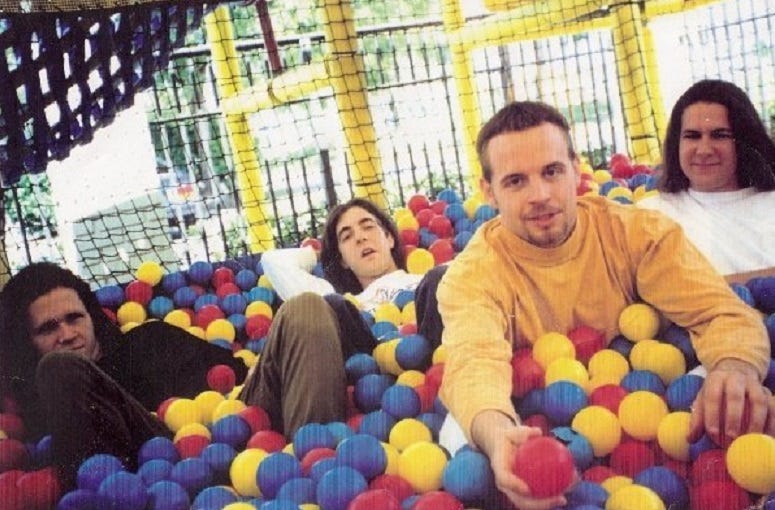
Dore Soul, 1994 (from left): Gary Norton (drums), James Hadzopolus (guitar), and Carey Peak (vocals); without Derek Sullivan (bass), they came the C-60s. Photo: From the J-Card of their cassette.


The hyper punk-pop of this Carey Peak-fronted trio (where he doubled on bass) birthed with the popular South Florida alt-rock quartet, Dore Soul (1990–1994), managed and produced by local rock entrepreneur Gary Styder of locally-famed Gled Studios whose work in the marketplace dates to the early days of Tuff Luck.

Courtesy of local college and commercial radio airplay for their catchy, radio-friendly songs “Breathe” and “Full in You,” Dore Soul’s popularity grew on the region’s early-to-mid ’90s, burgeoning alternative club scene alongside the newly-formed, alt-gothic metal outfit Marilyn Manson and the rap-metal crossover concern Collapsing Lungs. Signing a management deal with local impresario John Tovar — again, who negotiated the careers Nuclear Valdez and the Mavericks to major label deals — Dore Soul garnered interest from Sony (home to the since dropped Nuclear Valdez), Interscope, and Atlantic; the latter two signed respective deals with Marilyn Manson and Collapsing Lungs, instead.


Resolute, Dore Soul self-released two full-length, controversially-titled cassettes: Bl*w J*b (1993) and The New Sh*t (1994); however, by that point, national, as well as local interest in the grunge-inspired alternative scene, cooled; label interest in the band waned, once hot local clubs were closing. So Dore Soul split.

The reconstituted trio-version of Dore Soul as the C-60s played their first show opening a 1997 Fort Lauderdale club date for Self: a chart-rising alt-rock band fronted by Matt Mahaffey. Impressed, the multi-instrumentalist and producer offered a deal on his Mufreesboro, Tennessee-based imprint Spongebath Records, itself a subsidiary of Enclave Records operated by (yep, there he is: again) Tom Zutaut: a former A&R executive with Geffen Records best known for signing Guns N’ Roses and Mötley Crüe.


Courtesy of Peak’s kinetic, infectious writing and singing, “Remote Control,” the lead single from the C-60s self-titled debut (1998), was quickly accepted by college radio; a commercial crossover was on the horizon.

That was until Enclave’s parent company, Dreamworks Records — founded in 1996 by David Geffen as a subsidiary of Dreamworks Pictures, itself a motion picture studio founded by Geffen, along with studio executive Jeffrey Katzenberg, and filmmaker Steven Speilberg — split from Dreamworks Pictures.

Then, Enclave’s new distributor, EMI Records, folded the imprint into Virgin Records, leading its June 1997 shutdown (and that EMI shuffling contributed to the Hazies losing their deal). Mercury Records reactivated Enclave later that year; their parent, Polygram Universal, shuttered Enclave, once again, for the last time in 1999. The changes left the still-operating Spongebath as a struggling independent label unable to offer distribution, radio promotion, or tour support — rife with rumors of behind-the-scenes money mismanagement and alleged embezzlement scuttling the label once and for all.

So, the C-60s broke up.


In November 2021, the music of the C-60s previous incarnation, Dore Soul, appeared on the soundtrack for the Showtime original series Yellowjackets (S1:E1), with “What If . . . ” from their second cassette. In 2023, “Just,” from their debut cassette, appears on the soundtrack to the Canadian-produced, independent drama, Seagrass. Both of Dore Soul’s tapes have since been digitally remastered by Phoenix, Arizona-based Fervor Records, an independent label specializing in acquiring previously released and unreleased demo catalogs of unsigned bands for the purposing of offering affordable music licensing alternatives to advertising agencies, as well as low-budget cable television and streaming series.

* * *

You can enjoy the reissued and digitized version of the Bl*w J*b and The New Sh*t cassettes from Dore Soul, as well as self-titled debut by the C-60s, on Over the Edge Radio You Tube.

Below is the big local hit, “Breathe,” which should have been a huge national alt-rock hit alongside the likes of Possum Dixon with “Watch the Girl Destroy Me,” the Toadies with “Possum Kingdom,” and Tripping Daisy with “I Got a Girl,” as well as so many other MTV 120 Minutes delights. The same holds true for “Remote Control” by the C-60s: right up there with the still-programmed — on “classic hits” radio, no less — “Sex and Candy” by Marcy’s Playground and “Closing Time” by Semisonic.

Too bad The MTV Basement Tapes weren’t around in the 120 Minutes ’90s . . . Dore Soul would have won their semi-final round, then taken the recording contract grand prize (denied earlier to South Florida’s own Slyder and Z-Toyz) by an overwhelming landslide. No doubt: the writing and composition skills of Carey Peak were that good.

14. Mary Karlzen 1992–1995 (Fort Lauderdale/Atlantic)

The Mary Karlzen Band, 1992 (from left): Wayne Glass (drums), Chuck Anton (fiddle), Mary Karlzen (vocals/acoustic guitar), Mark Scandariato (electric guitar/vocals) and Tracy Wilcox (bass). Photo: Y&T Records.

So where did Mary Karzlen’s countrified alt-pop sensibilities fail where Meredith Brooks, Melissa Ethridge, and the Indigo Girls — as well as the younger alt-driven Abra Moore and Jill Sobule, and the indie-to-major label female-driven outfits Belly, the Breeders, and Letters to Cleo — succeed in the all-new “rock alternative” radio format developed in the early ’90s (those stations played “Cornflake Girl” by Tori Amos, after all). Where did Karlzen fail where country’s gold and platinum-selling Mindy McCready and Grammy Award-winning Shelby Lynne, succeeded?

The talent was there. So was the support from Y&T Records. A nationally recognized independent, the Miami-based label assisted in the career development of the multi-nominated and award-winning alternative-country outfit, the Mavericks — who signed with MCA Records, and the career cut-too-short For Squirrels — who signed with Epic.

Karlzen’s name-checked influences of biographical songwriters were there, as well. One could hear hints of Jackson Browne, Johnny Cash, Elvis Costello, Joni Mitchell, Bruce Springsteen and James Taylor shine on her major label debut single, “I’d Be Lying,” which became a “Hot Pick” (in its indie EP version) on the VH 1 cable-video outlet.

In fact, the cable channel’s support dates prior to Atlantic Records releasing her debut album, Yelling at Mary (1995), when her country rock meets folk rock wares from her independently-released, five-song EP, Hide (1993), appeared on VH 1 (again, that “hot pick”), crowning Karlzen as the network’s most played independent artist of all time. The video for the second single release from the EP, “A Long Time Ago,” was also programmed on the Americana TV Network, Country Music Television, and The Nashville Network. Music critics at major metropolitan newspapers were quick to (justifiably) rave about Karlzen’s songs; so did the music and broadcasting publications Billboard and Radio & Records.

Then, the raves, stopped.

Perhaps it was Karlzen’s outspokenness (cue Tampa’s Shadowland) against country radio as “a haven for plastic, cloned Barbie dolls; Stepford [Wives] singers with perfect hair and bodies who don’t write their own songs.” (That’s no way to book a beneficial opening tour slot with the career-hot Mindy McCready or Shelby Lynne.) Perhaps it was her antithesis-styled album cover — featuring her as a frumpy farmgirl clad in unbecoming denim overalls while slouching her shoulders (someone was “yelling” at her, after all) that turned away buyers and radio programmers.

Sure, Karlzen toured the U.S and Canada opening for the likes of Jackson Browne, Bob Dylan, John Haitt, Hootie & the Blowfish, and Warren Zevon — but the hit-making days and concert draw of those now “nostalgia” artists were in the past and not favorable to the younger, fickle alternative audience needed for chart placement. Yes, Karlzen charted in the “Top 20” on triple-A (Adult Album Alternative) stations in the U.S — but the never-commercially viable format failed to crossover-to-mainstream in the alt-crazy ’90s as result of its genre-diverse programming (from blues-to-folk-to-Americana-to-country-to-rock-to-jazz-to-rap) regulated to low-rated, non-commercial educational radio stations.

It all began for Mary Karlzen on the South Florida scene in the late 1980s as part of the all-female, Americana-styled outfit, Vesper Sparrow. A talent-to-spare, multi-instrumental quartet featuring Karlzen (primarily on bass) trading lead vocals with Kelly Christy, the band quickly became a top draw on South Florida’s alternative scene, complete with a local hit, “Highway,” from their label-shopped demo backed by Y&T Records.

The time came for the major labels to take notice.

Then, after a 1989 industry showcase at New York’s infamous CBGB’s during the CMJ (College Music Journal) Music Conference: Vesper Sparrow, imploded.

Vesper Sparrow, 1988 (from left): Rose Guilot (guitar), Mary Karlzen (vocals/bass), Carolyn Colachicco (drums) and Kelly Christy (vocals/guitar). Image: Y&T Records.

Kelly Cristy of Vesper Sparrow back stage at a July 4, 1989, where the band opened for the Connells at Respectable Street Cafe in West Palm Beach, Florida. Image from The Hard Report, pg. 34 #141, August 11, 1989.
Kelly Christy of Vesper Sparrow back stage at a July 4, 1989,
show when the band opened for the Connells
at Respectable Street Cafe in West Palm Beach.
Image from "The Hard Report," pg. 34 #141, August 11, 1989.

Karlzen’s roots — and respect — on the South Florida local scene ran deep: Deep enough that she provided violin to the Marilyn Manson-fronted side-collective Mrs. Scabtree (during the early-1993 Portrait of An American Family sessions). The same holds true for her long-time, lead electric guitarist, Mark Scandariato.

Scandariato’s South Florida roots date the early ’80s when his band, the Terminals, shared the area’s stages with Johnny Depp’s the Kids and Andy Panik and Bobby Durango’s the Abusers (that collectively became the Rock City Angels); Scandariato was also a short-time member in a nascent version of Love Canal. Scandariato’s friendship with Depp ran deep enough that, when the Miramar, Florida, native returned to film his second feature film, Private Resort (1985), the Terminals were cast as the resort’s house band; two songs by the Terminals, “You” and “Miami Calypso,” appear on the soundtrack. Unfortunately, as with Johnny Depp’s the Kids making their soundtrack appearance on The Legend of Billie Jean (1985): the movie flopped, no soundtrack was issued, and provided no promotional upwind for the Terminals.

A 1989 gig by Vesper Sparrow opening for
locals Paragon at The Treehouse in Hallandale.
Known as a thrash metal stronghold for
the under-25 crowd, the venue jumped on the
then-trendy alternative scene by giving
a night to non-metal locals.


As for Mary Karlzen: She returned to the college rock indie scene where she got her start, releasing the albums Dim the Watershed (1999), The Wanderlust Diaries (2006), and Shine (2021). Y&T Records digitized the 15-song catalog of Vesper Sparrow under the title, What the Birds Say (2023). Mark Scandariato returned to South Florida stages with Satellite Six, which released a nationally-distributed album through Y&T Records, Love & Fear (1998), that failed to gain major label interest; the same unfortunate disinterest followed for the band’s sophomore effort, under their revised moniker, Plowman. In the aughts, Scandariato currently fronts the quartet Maypo Deluxe, which since released four albums: Weedzie, Going Steady, Home Coming, and Bad Dreams.

* * *

You can listen to Mary Karlzen's self-titled debut and the Hide (EP), and Yelling at Mary, as well as the music of Vesper Sparrow and Satellite Six on Over the Edge Radio You Tube. You can learn more about Maypo Deluxe on Facebook, You Tube, and their official website.


13. For Squirrels 1992–1996 (Gainesville/Epic)

For Squirrels, 1994 (from left): Jack Griego (drums),
Jack Vigliatura (vocals), Bill White (bassist)
and Travis Tooke (guitar).
Photo: Y&T Records promotional.

There’s rock ’n’ roll tragedies . . . then there’s the fate of this REM meets Nirvana quartet with a sound that should have taken them to the top of the charts alongside the like-minded Collective Soul and 7 Mary 3.

As with the Mavericks and the Mary Karlzen Band signing major label deals under his tutelage, local store owner Rich Ulloa of Miami’s Yesterday and Today Records knew a great band when he heard one: So he assisted For Squirrels (so committed to being in a band, they would play music “for squirrels”) in the studio with the indie releases Baypath Rd., and its five-song EP outgrowth, Plymouth (both 1994), on his Y&T Music imprint. The major labels took notice, as result, with Epic Record’s alt-rock subsidiary, 550 Music, signing the band.

Then, tragedy stuck.

On September 8, 1995, while returning from a well-received showcase at CBGB’s for the annual CMJ Music Conference in New York City, the band was involved in a tour van accident in Georgia, about 75 miles north of the Florida border. The single-vehicle accident-by-tire blowout claimed the lives of vocalist Jack Vigliatura, 21, bassist Bill White, 23, and manager Tim Bender, 23 (considered the band’s unofficial fifth member).

To the corporate suites at Epic Records credit: They released the debut album, Example — produced by Nick Launay, known for his work with Midnight Oil and the Talking Heads — as scheduled, on October 3, 1995. The lead single, “Mighty K.C,” ironically, about the tragic death of Kurt Cobain, became a minor, mainstream “rock alternative” hit, while college radio and triple-A non-commercial stations turned the follow up singles, “Superstar” and “8:02 PM,” into alternative hits.

A few months after the 1995 accident, surviving members guitarist Travis Tooke and drummer Jack Greigo drafted their old school friend Andy Lord on bass. Now, with Tooke on lead vocals for the deceased Vigliatura, they resurrected the For Squirrels moniker, playing low-key dates around Gainesville. As they began writing new material, a heavier grunge sound, developed; by 1996, with a new lease on life by way of the new material, the trio became known as Subrosa.

Subrosa, 1997 (from left); Jack Griego (drums), Travis Tooke (vocals/guitar)
and Andy Lord (bass). Photo: Epic Records.

Impressed with their comeback from tragedy, Sony Records released the band’s only album, Never Bet the Devil Your Head, which featured the video single release, “Buzzard” (1997). Adding a second guitarist in fellow Gainesville scenester Mike Amish for touring, the band opened for fellow Floridians, Creed. Sadly, a prime tour slot couldn’t overcome the record’s slow sales and scant radio airplay. In spite of favorable critical response that should have allowed for a second album, Subrosa was dropped, but pressed on as an independent act until 2001.

Ex-Squirrel Travis Tooke continued to make music on the Gainesville scene with Helixglow, while Subrosians Andy Lord and Mike Amish continued with their band, Papercranes.

* * *

You can listen to For Squirrel's Baypath Rd. and Example, in addition to Subrosa's Never Bet the Devil Your Head on Over the Edge Radio You Tube. Subrosa's independent releases are discovered on their own You Tube page.

12. Collapsing Lungs 1991–1994 (Fort Lauderdale/Atlantic)

Collapsing Lungs, 1994 (from left): Mark Carpenter (bass), Kyle “Embryo” Henrich (keyboards), Brian Tutunick (vocals), Frank “Crime” Cassara (samples/percussionist/vocals), Chris Nicolas (keyboards), Pete Gross (guitar) and Chris Goldbach (drums). Photo: Atlantic Records, from their press kit.


This industrialized, nu metal septet was fronted by Brian Tutunick, known in the Marilyn Manson lexicon as “Olivia Newton Bundy,” the band’s first bassist, from its days as a drum machine-backed quartet. Perry Pandrea, aka Zsa Zsa Speck — who formed the precursor, Mirror Mirror, with Brian Warner, aka Marilyn Manson — along with Tutunick, became ex-Spooky Kids in 1990 after the upstarts’ fourth local club date. The duo formed Collapsing Lungs in 1991, soon issuing (without Pandrea) a five-song cassette, Parental Advisory Explicit Lyrics (1992).

Courtesy of Marilyn Manson garnering major label interest, labels began poking around South Florida and noticed Collapsing Lungs’ quick development as a standing-room-only club act — courtesy of the local radio hits “Crackerjack” and “Let’s Play a Game” to their credit.


Impressing Atlantic Records at an all-ages showcase at South Florida’s premiere national tour stop for metal bands, The Plus-Five Lounge, as well as at the mainstream alt-rock stop, The Edge (both defunct), the band issued the five-song debut effort, Colorblind (1994).

While MTV added the video for “Crackerjack” to their respective, weekend alternative and metal block programs 120 Minutes and Headbanger’s Ball, and the burgeoning, Dallas-based national radio network Z-Rock added the lead single to “active rotation” (alongside Seattle underdogs, the Melvins), the now hair metal-ignoring active rock radio format and newly-instituted “rock alternative” stations (again, more interested in the “alt-safe” Crash Test Dummies and Spin Doctors) ignored the band. A tumultuous tour ensued (their touring-Winnebago constantly breaking down) resulting in Brian Tutunick leaving the band he created.


The remaining members of the septet — now a sextet with sampler and second vocalist Frank “Crime” Cassara as lead vocalist — quickly regrouped as L.U.N.G.S (depending on the source: an acronym for “Life Under No Greedy Suckers” or “Losers Usually Never Get Signed”). As Atlantic lost interest in the beleaguered band, they signed with the Arizona-based metal specialty imprint Pavement Records, which released the radio and retail ignored Better Class of Loser (1996), featuring the single, “Pull It Off.”

Brian Tutunick returned to Florida stages in 1996 with the electronica/industrial concern Nation of Fear, which released an eponymous full-length effort (1996) and Everything Beautiful Rusts (1999); he followed with the like-minded, Orlando-based Depravity Scale (2011). Frank “Crime” Cassara returned with the punk band, the Mary Tyler Whores. Drummer Chris Goldbach — who sat on the kits for both ’Lungs concerns — did the same for the popular Florida punk bands RadioBaghdad (which also featured Pete Gross) and Against All Authority.


Collapsing Lungs is a case of an innovative band too soon: No sooner did the band split, Jacksonville, Florida, native Fred Durst formulated the analogous-sounding Limp Bizkit in 1994. Nominated for three Grammy Awards, their brand of fusing hard core punk and urban hip hop with ’80s heavy metal and European-industrial sold over 40 million records worldwide — alongside analogous platinum sellers KORN and Linkin Park.

A short-lived Collapsing Lungs reunion occurred in 2020 as lead vocalist Brian Tutunick, Pete Gross, Mark Carpenter, and Chris Nicholas released series of streaming-singles as a precursor to a full-length album that never occurred.

* * *

You can enjoy Collapsing Lungs' P.A.E.L demo and Colorblind, as well as Better Class of Losers from L.U.N.G.S, and the complete discography of Nation of Fear, on Over the Edge Radio You Tube. 

11. Super Transatlantic 1998–2000 (Fort Lauderdale/Universal)

Super Transatlantic, 2000 (not in order):
Jason Bieler (vocals/guitar; second from right), Pete Dembrowski (guitar),
Pete Badger (bass) and Rick Sanders (drums).
Photo: Universal Music Group, from the album.

Succeeding nationally where fellow local-to-major label acts Cryer, Tuff Luck, and Young Turk, failed: Fort Lauderdale’s Saigon Kick — when compared to those SRO-club bands — was an odd, rocking duck: They weren’t glam. They weren’t grunge. They weren’t Ratt or Warrant. They weren’t Alice in Chains or Soundgarden, either. What guitarist Jason Bieler and vocalist Matt Kramer were: great songwriters — with two local-that-should-have-been-national-hits with “What You Say” and “Love of God” (appeared on their later, debut album) — whose glam-flashy, alternative-flirting repertoire packed clubs not only in South Florida, but across the state. The industry concert trade, Cash Box, when reviewing the band’s major-label debut, accurately summed Saigon Kick’s diversity as a fusion of hard rock and heavy metal crossed with ’60s-inspired psychedelia (Hey, didn’t Tampa’s critic-maligned Shadowland, do that?) meeting ’80s punk to create an aggressive yet melodic album; Billboard appreciated the band’s pop-heavy, Beatles meets Led Zeppelin influences.

While the local-to-state buzz lead to the hard rock quartet becoming the debut release on actor Micheal Douglas’s recently incorporated Third Stone Records/Atlantic imprint: the buzz didn’t translate nationally. The band’s extensive touring only managed a minor chart showing for the self-titled debut (1991) that topped out at a 100,000 copies. Meanwhile: Virgin Records dropped Tampa’s Roxx Gang for selling a mere 250,000 copies.

Saigon Kick should consider themselves lucky: and probably did, at the time.

So much for an album featuring stellar production values by ex-Accept guitarist and producer Michael Wagner who produced or mixed multi-platinum albums for the like-minded Alice Cooper, Dokken, Great White, Keel, Poison, Skid Row, and White Lion. The failure certainly wasn’t the label’s fault: “Coming Home,” from the debut, appeared on the soundtrack to the Brian Bosworth-starring film, Stone Cold (1991), while the aggressive “Body Bags” from their second, appeared in the Charlie Sheen-starring action film, Beyond the Law. So, the label was making the push, as it were.

So, what went wrong?

The band scoring a “Top 20” single . . . that became both a blessing and a curse: that’s what.

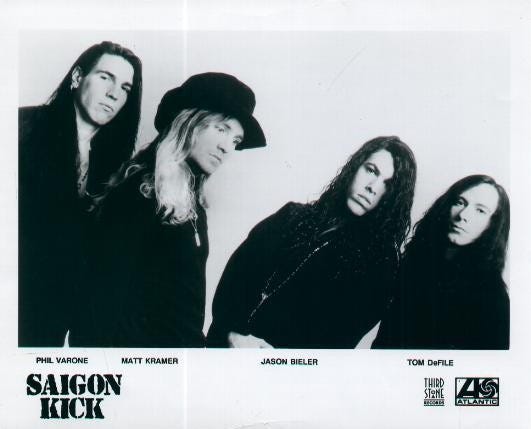
Saigon Kick, 1991. Photo: Atlantic Records/Discogs.

Fueled by the Jason Bieler-penned lead single, “Love Is on the Way” — an acoustic “power ballad” untypical of the rest of their sophomore effort, The Lizard (1992), as well as their repertoire in whole (they covered the Sex Pistols in concert) — the album achieved a 500,000-plus gold-certification, while the single became the band’s only Billboard “Hot 100,” gold-certified single.

Uh, oh. Here comes trouble.

Cue the band infighting during the recording of their tentative third album, most likely from label pressures to write “Love Is on the Way: Part II” while the band wanted to go (according to reports) in a more timely direction of Alice in Chains. So Matt Kramer and bassist Tom DeFile, left.

The Edge: Our dumpy, stinky home away from home,
down by the railroad tracks off of Andrews Avenue.


Now, paired to a trio of Jason Bieler on lead vocals and guitars, with Chris McLernon, formerly of Cold Sweat (know your Keel/Dokken histories) on bass, and still-on-the-stool Phil Varone, the band released Water (1993). Yeah . . . when Billboard name drops “Hallmark [moment]” in an album review: you know you’re getting, well, dropped. So does selling a measly 70,000 copies.

As talent-resilient as Ronnie Garvin with Stranger and Kevin Steele with Roxx Gang: Jason Bieler returned to South Florida — expanding Saigon Kick back to a quartet with guitarist Pete Dembrowski (his band debut)— to write a new batch of songs. Courtesy of interest by American indie-retro label CMC International, Saigon Kick returned with their fourth album — which sold an embarrassing 15,000 copies. Their fifth and final album — now featuring Rick Sanders on the drum seat (his band debut) — Bastards (1999), fared worse.

It’s time for a retooling of the Saigon Kick brand: Super Transatlantic was born.


Well, not before the 1997 return of Matt Kramer on lead vocals — expanding the band to a first-time quintet — and the recording of a one-off song, “Dizzy’s Vine.” This time, after two live shows: Jason Bieler left the band. By 2000, the Bieler-less Saigon Kick — with original members Kramer, Tom DeFile, and Phil Varone, and Jeff Blando (of DeFile’s failed post-’Kick band, Left for Dead) in for Bieler — fizzed out before it even started. Another series of failed reunions continued between 2012 to 2015 with guitarist Steve Gibb — the son of the Bee Gees’ Barry Gibb and a member of Crowbar and Black Label Society — and drummer Jonathan Mover of the British prog-rock bands Marillion and GTR — a part of those configurations.


As for Saigon Kick 2.0, aka Super Transatlantic: Then unsigned, the South Florida-based quartet began as a short-lived local “supergroup” featuring Jason Bieler on lead vocals, with Erik Kothern on guitar and Jeff Libman on drums (both formerly with a popular Miami-based alt-rock band, Naked Rhythm; without either: the band signed to Germany’s Massacre Records) and bassist George Fotiadias (formerly with the hard-alternative concern Love Canal).

By the time the band — well, Jason Bieler — signed a new deal with the MCA-affiliated Universal Music, the band and its related album, Shuttlecock (2000), was essentially a sixth Saigon Kick album — since the band now featured later-day Saigon Kickers’ Pete Dembrowksi and Ricky Sanders, only now with former Extreme bassist Pete Badger (yes, the “More Than Words” guys; another great band ruined by the “power ballad” curse).

As with Saigon Kick: Super Transatlantic received a soundtrack-promotional push with their heavy-pop lead single, “Super Down,” appearing on the soundtrack to the teen-sex comedy runaway box office hit, American Pie (1999).

And while everyone loved the movie: radio programmers and the record buying public didn’t care about Super Transatlantic . . . but this writer did: a wonderful album, indeed, Jason.

Across the naughts, Jason Bieler self-released a series of solo EPs. Matt Kramer released his own, indie-solo debut, War & Peas (2002). Phil Varone formed another, short-lived local “supergroup” with Young Turk bassist Bill McKelvy known as Planet Boom. Tom DeFile did the same, with Los Angeles-to-South Florida transplanted members from Queen Anne’s Revenge, Trouble Tribe, and Beggars & Thieves as Left for Dead. None of the projects garnered major label interest. Another of Varone’s post-Saigon Kick projects was ex-Skid Row Rachel Bolan’s late ’90s concern, Prunella Scales, which transitioned to Varone’s short-lived membership in a reformed Skid Row.

* * *

You can enjoy Super Transatlantic, Naked Rhythm, and Love Canal's Embers and Home and, in our In the Cabinet: Lost South Florida Local Tapes, the demos from Left for Dead and Saigon Kick's The Lizard, as well as well as Saigon Kick's debut album and early demos, on Over the Edge Radio You Tube.