 |
| Sugarspoon,
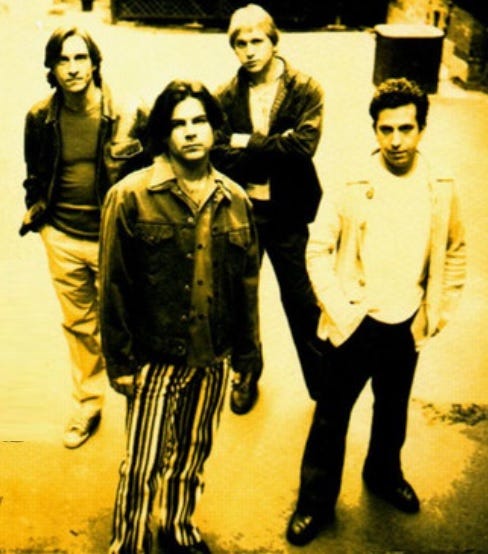
1996 (not in order): Paul Sizemore (vocals/guitar), Kent Bradley (guitar), Jeff McDonald (bass) and Mark Henry (drums).Photo: MCA, from the album. |
While
Shadowland packed up and moved to L.A and the Hazies continued to slug
it out on Florida stages, Sugarspoon (for fans of the singles-infectious
Gin Blossoms and Toad the Wet Sprocket), worked in reverse: They
eschewed club dates, instead perfecting their songs to record the
perfect demo tape — at Tampa’s world-famous Morrisound Studios (know
your death metal scene) — to sign a major label deal. (Another Tampa band, Julliet, tied back to the history of Z-Toyz, also made an L.A move.)
Locals in Tampa knew scene veterans Paul Sisemore, Jeff McDonald, Kent Bradley, and Mark Henry quite well, by way of their collective, well-received, major-label hopefuls the Love Dogs, Secret Service, and the Warren Brothers.
Paul Sisemore — in terms of releasing nationally-distributed product — was the most successful of Sugarspoon’s roster, having been a member of the Florida-based Ben Schultz Band (1992): a band co-founded by bassist Tim Bogert (’70s classic rockers Vanilla Fudge and Cactus) and the Tampa-based Ben Schultz, who worked on major-label releases since the ’70s (Wizard, Pipedream, KGB, Barefoot Servants). It was through those industry connections — which expanded by way of Sisemore and guitarist Kent Bradley knocking around the early ’90s Los Angeles rock scene with Straight Monkey (1993) that flirted with major label overtures — that the duo organized industry (six) showcases in Tampa clubs. MCA Records was the first label to response to the invite.
Drummer Mark Henry, also flirted with a major label deal for his Tampa band, Secret Service. Sadly, a mere week after that band’s lead singer, Steve Gruden, passed away, Warner Bros. Records offered the band a deal. Dejected, Henry left Tampa in 1994 for the greener pastures of upstate Ithaca, New York. Sisemore and Bradley’s demos convinced him to return to Tampa.
Then, the music industry consolidations of labels and the cancelling of recording contracts occurred— in the wake of the Federal Communications Commission Telecommunications Act of 1996 triggering the consolidation and homogenization of radio stations, thus, killing off the once-hot “rock alternative” rock format — well, MCA Records, which signed the band in May 1995, lost interest.
A year passes.
Sugarspoon, finally, recorded their debut (as it turned out: only album) in February 1996. The first single, “Like Shine,” was released in mid-July; the album in mid-August. To hear the band tell it in interviews: they didn’t know of the schedule until a week before the single was released.
Even with the label’s scant promotion, “Like Shine” did reasonable well on the “Modern Rock” charts, but never crossed over to commercial “rock alternative” radio; their follow up single, “Butterfly Breeze,” failed to chart. As good as Sisemore and Bradley’s goes-down-like-gumdrops songs were: a “Hey Jealousy” or “All I Want” styled-chart topper and a now “classic alternative” hit wasn’t meant to be.
Adopting Sugarspoon’s lone hit song as a band name, Paul Sisemore issued more like-minded alternative pop with Likeshine and the album, Living Room (2003), and as Sisemore, The Disillusionment of Youth and the American Way (2011).
Sadly, we lost Kent Bradley along the way. His popsmith legacy lives on in the nickle-collated digitized grooves of Sugarspoon.
* * *
You can enjoy the lone release by Sugarspoon on Over the Edge Radio You Tube.


No comments:
Post a Comment