 |
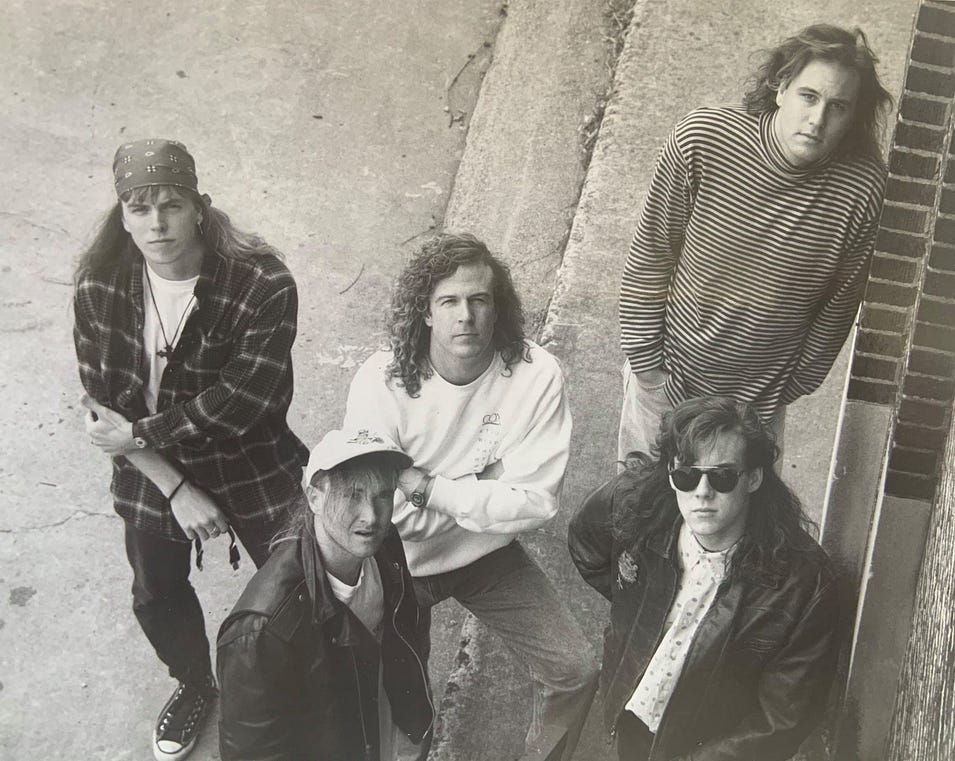
| The Hazies — then UROK — 1991: Photo: The Hazies Facebook. |
Remember the in-joke in Tom Hanks’s writing and directorial rock ’n’ roll love letter, That Thing You Do! (1996), about Erie, Pennsylvania’s the “One-ders” — where no one picked up on the esoteric “Wonders” spelling and kept calling the band, the “Oh-NEED-ers”?
Well, back in 1991, when the Hazies began playing out as RUOK, aka “Are You Okay?”, no one got the acronym, either; so they changed their name to UROK, aka “You Are Okay” — but their ever-growing local fanbase referred to them as “You Rock.” The band gave up: the fan-made moniker, stuck (you should have used periods, like the L.U.N.G.S; a band we’ll discuss, later).
Okay, well . . . how did UROK end up with the Hazies branding?
At the time, an A&R executive with EMI Records, which was courting the band, referred to a local music ragazine’s positive take on the band’s sound as “a psychedelic haze”: The Hazies were born.
As UROK, the quartet’s brand of “groove rock” expanded from their west coast, Tampa-Clearwater-Ybor City base into the central Florida cities of Gainesville and Ocala to the north, and south into Miami-Fort Lauderdale. Their self-titled debut EP (1990) and the full-length cassette, Fashionable Sedate (1992), expanded the band’s reach further, as they gained airplay on college radio stations not only in Florida, but across the Southeast, particular in Atlanta, Georgia.
Signed to EMI Records, their major label debut, Vinnie Smokin’ the Big Room (1996), was instantly accepted on college radio and did reasonably well on commercial-alternative rock radio stations with the lead single, “Skin & Bones,” and the follow-up, “Trip Free Life,” reaching #7 and #11, respectively on the “Modern Rock” charts.
Then, under President Bill Clinton, the Federal Communications Commission (The FCC) enacted the first major overall of telecommunications law in 62 years. The Telecommunications Act of 1996, aka “Telcom Act,” deregulated the industry nationwide, removing local ownership caps allowing for the national consolidation of broadcasting outlets. The wave of mergers and acquisitions — as larger corporations bought out smaller, local broadcasting companies — lead to a flurry of format changes. In the two years since Kurt Cobain died, the frenzy for all things alternative on rock radio, cooled. Computer automation replaced disc jockeys.
Overnight, as those radio outlets disappeared though homogenization, and with record companies seeing the bottom line: it triggered a wave of consolidations in the record industry. Labels began to streamline their operations and artist rosters — including EMI Records.
The Hazies were lost . . . in the haze.
After a halfhearted attempt to promote the band, by way of a cover of the Vapor’s new wave classic, “Turning Japanese,” for the soundtrack to the Chris Farley-starring Beverly Hills Ninja (1997): it was all over.
Through their record company ups and downs on their travels though the MTV 120 Minutes alternative generation, the Hazies continue to record and tour independently into their 34th year. The band self-remaster UROK’s debut release, Fashionable Sedate, for the digital crowd — with the original artwork intact and “the Hazies” moniker added to artwork.
* * *
You can enjoy the recordings of the Hazies and UROK on Over the Edge Radio You Tube.


No comments:
Post a Comment