 |
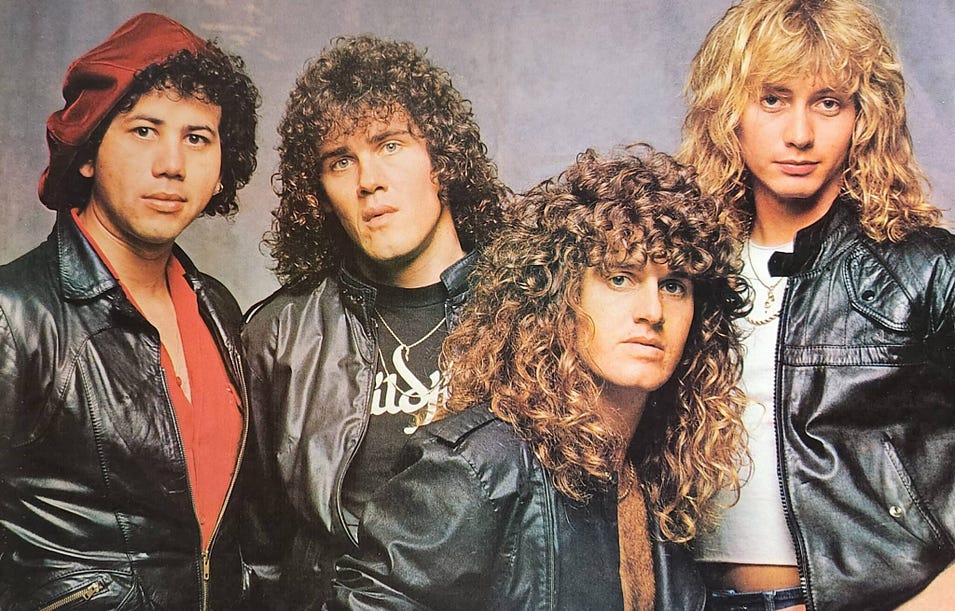
| Stranger, 1982 (from left): Tom “King” Cardenas (bass), John Price (drums), Greg Billings (vocals) and Ronnie Garvin (guitar). Photo: Epic Records. |
Lead by Charleston, South Carolina-born, hard rock lead guitarist Ronnie Garvin, the Tampa-based band Stranger — which tinkered with the oh-so-hair-metal names Lynxx and Romeo before settling — became a top club draw across the state, particularly in South Florida, courtesy of the band’s numerous appearances at the long-since-gone, infamous hair metal joints of Art Stock’s Playpen South, The Button South, Rosebuds, and Summers on the Beach in Fort Lauderdale, and Hallandale’s Agora Ballroom, later known as The Button South (in which Johnny Depp’s local band, the Kids, became a popular draw). Those standing-room-only shows caught the attention of American record producer and A&R executive Tom Werman, who brought Boston, Cheap Trick, REO Speedwagon, and Ted Nugent to Epic Records; during his tenure with Elektra Records: his discoveries of Dokken and Mötley Crüe rose to the top to the charts; as an independent-for-hire, he accomplished the same for Twisted Sister.
Where did Stranger fail — where their Epic label mates, Jacksonsville, Florida’s platinum-selling Molly Hatchet (four million copies across three albums), succeeded?
Ronnie Garvin’s long-gestating, self-titled debut album (1982) was critically well received; the album’s lead track, “Swamp Woman,” and its follow-up, “Jackie’s So Bad,” received national airplay (but failed to reach the coveted “Top 40”) courtesy of Stranger’s incessant touring with Aldo Nova, Eddie Money, Quiet Riot, Triumph, Robin Trower, and UFO.
Well, even in a post-Van Halen world where rock hounds and metal heads alike made Circus and Hit Parader best-selling music magazines in the States, guitar-driven hard rock continued fighting for acceptance on commercial FM radio and MTV against synth-driven new wave and post-punk bands in the early ’80s, such as the Cars, the Knack, Gary Numan, and Missing Persons.
 | |
| Stranger were regulars at Summers on the Beach in Fort Lauderdale, January 1989. Personal scan from my ragazine collection. |
Then, the band’s main supporter, Tom Werman, left Epic Records in late 1982 for a job with Elektra Records. It didn’t help that their manager, industry-heavy hitter Pat Armstrong, invested more time with his platinum-selling clients Molly Hatchet and Quiet Riot.
That triggered the serving of a cease-and-desist and paid-out by Epic to the band — in the middle of recording their sophomore effort tentatively titled, Runnin’ in the Red.
Undeterred, Ronnie Garvin and Stranger returned to Tampa, picking up where they left off: as a top draw on the Florida club circuit. Stranger was a large enough of a draw that, when Tom Petty was on vacation visiting friends and family in Gainesville, he jumped on stage at The Islands rock club to jam with the band. Once again — and with “hair metal” on the rise in late ’80s (Ratt, Slaughter, Warrant, Winger), a genre where Stranger’s brand of rock ’n’ roll seemed well-suited — the major labels expressed a renewed interest; but a second deal, this time with Atlantic (the home of the Werman-mentored Twisted Sister), wasn’t meant to be.
 |
| You can't keep a good band down . . . Stranger releases music on their own, December 1988. Personal scan from my ragazine collection. |
Then, the band made a comeback, of sorts, courtesy of MTV.
In conjunction with the Yamaha Corporation, the video music channel hosted the 1988 Yamaha Sound Check/MTV International Rock Competition, where “Tampa’s Best Band” opened for Cheap Trick with several other finalists as part of the December event in Hollywood, California. Two members of Stranger won “best of” awards, as determined by a panel featuring Jon Bon Jovi and Quincy Jones, as well as various A&R and record company executives: Ronnie Garvin won best guitarist and Tom Cardenas for best bassist. Unfortunately, the band came in second place among the seven bands — and worse: a new deal wasn't forthcoming.
So, Garvin pressed on, incorporating his own vanity-press, Thunder Bay Records, to release Stranger’s second album, No Rules (1989), and third, No More Dirty Deals (1991) — the latter served as the soundtrack to a low-budget, shot-in-Florida action flick of the same name (1993). By the early ’90s — with Donnie Lee replacing long-time original vocalist Greg Billings — two more Thunder Bay-released albums followed: We Be Live (1993), and the final studio album, Angry Dogs (1995), but by then — as with the new wave scene before: the arrival of grunge stymied the band’s chances to return to the majors.
Sadly, the band’s break-up in 1996, in conjunction with martial problems, resulted in Ronnie Garvin’s shotgun suicide at the age of 37 on October 7, 1996.
* * *
Listen to both of the albums by Stranger -- Stranger (1982) and No Rules (1989) -- on Over the Edge Radio You Tube. Photos and press clippings from Stranger abound on the Tampa Music Archives Facebook page (provided you have an account).
It gives me great joy to hear the new class of internet-radio outlets in 2025 remembering and programming Stranger amid the other classic rock bands of the day.


No comments:
Post a Comment