 |
| Super
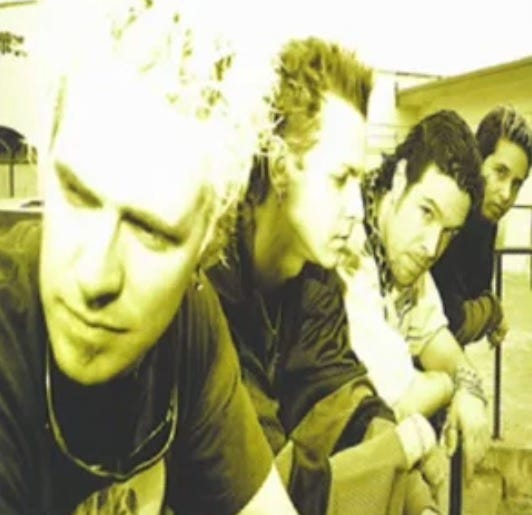
Transatlantic, 2000 (not in order): Jason Bieler (vocals/guitar; second from right), Pete Dembrowski (guitar), Pete Badger (bass) and Rick Sanders (drums). Photo: Universal Music Group, from the album. |
Succeeding nationally where fellow local-to-major label acts Cryer, Tuff Luck, and Young Turk, failed: Fort Lauderdale’s Saigon Kick — when compared to those SRO-club bands — was an odd, rocking duck: They weren’t glam. They weren’t grunge. They weren’t Ratt or Warrant. They weren’t Alice in Chains or Soundgarden, either. What guitarist Jason Bieler and vocalist Matt Kramer were: great songwriters — with two local-that-should-have-been-national-hits with “What You Say” and “Love of God” (appeared on their later, debut album) — whose glam-flashy, alternative-flirting repertoire packed clubs not only in South Florida, but across the state. The industry concert trade, Cash Box, when reviewing the band’s major-label debut, accurately summed Saigon Kick’s diversity as a fusion of hard rock and heavy metal crossed with ’60s-inspired psychedelia (Hey, didn’t Tampa’s critic-maligned Shadowland, do that?) meeting ’80s punk to create an aggressive yet melodic album; Billboard appreciated the band’s pop-heavy, Beatles meets Led Zeppelin influences.
While the local-to-state buzz lead to the hard rock quartet becoming the debut release on actor Micheal Douglas’s recently incorporated Third Stone Records/Atlantic imprint: the buzz didn’t translate nationally. The band’s extensive touring only managed a minor chart showing for the self-titled debut (1991) that topped out at a 100,000 copies. Meanwhile: Virgin Records dropped Tampa’s Roxx Gang for selling a mere 250,000 copies.
Saigon Kick should consider themselves lucky: and probably did, at the time.
So much for an album featuring stellar production values by ex-Accept guitarist and producer Michael Wagner who produced or mixed multi-platinum albums for the like-minded Alice Cooper, Dokken, Great White, Keel, Poison, Skid Row, and White Lion. The failure certainly wasn’t the label’s fault: “Coming Home,” from the debut, appeared on the soundtrack to the Brian Bosworth-starring film, Stone Cold (1991), while the aggressive “Body Bags” from their second, appeared in the Charlie Sheen-starring action film, Beyond the Law. So, the label was making the push, as it were.
So, what went wrong?
The band scoring a “Top 20” single . . . that became both a blessing and a curse: that’s what.
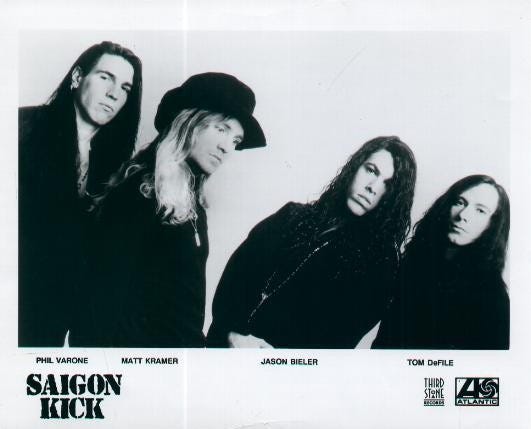 |
| Saigon Kick, 1991. Photo: Atlantic Records/Discogs. |
Fueled by the Jason Bieler-penned lead single, “Love Is on the Way” — an acoustic “power ballad” untypical of the rest of their sophomore effort, The Lizard (1992), as well as their repertoire in whole (they covered the Sex Pistols in concert) — the album achieved a 500,000-plus gold-certification, while the single became the band’s only Billboard “Hot 100,” gold-certified single.
Uh, oh. Here comes trouble.
Cue the band infighting during the recording of their tentative third album, most likely from label pressures to write “Love Is on the Way: Part II” while the band wanted to go (according to reports) in a more timely direction of Alice in Chains. So Matt Kramer and bassist Tom DeFile, left.
 |
| The Edge: Our dumpy, stinky home away from home, down by the railroad tracks off of Andrews Avenue. |
Now, paired to a trio of Jason Bieler on lead vocals and guitars, with Chris McLernon, formerly of Cold Sweat (know your Keel/Dokken histories) on bass, and still-on-the-stool Phil Varone, the band released Water (1993). Yeah . . . when Billboard name drops “Hallmark [moment]” in an album review: you know you’re getting, well, dropped. So does selling a measly 70,000 copies.
As talent-resilient as Ronnie Garvin with Stranger and Kevin Steele with Roxx Gang: Jason Bieler returned to South Florida — expanding Saigon Kick back to a quartet with guitarist Pete Dembrowski (his band debut)— to write a new batch of songs. Courtesy of interest by American indie-retro label CMC International, Saigon Kick returned with their fourth album — which sold an embarrassing 15,000 copies. Their fifth and final album — now featuring Rick Sanders on the drum seat (his band debut) — Bastards (1999), fared worse.
It’s time for a retooling of the Saigon Kick brand: Super Transatlantic was born.

Well, not before the 1997 return of Matt Kramer on lead vocals — expanding the band to a first-time quintet — and the recording of a one-off song, “Dizzy’s Vine.” This time, after two live shows: Jason Bieler left the band. By 2000, the Bieler-less Saigon Kick — with original members Kramer, Tom DeFile, and Phil Varone, and Jeff Blando (of DeFile’s failed post-’Kick band, Left for Dead) in for Bieler — fizzed out before it even started. Another series of failed reunions continued between 2012 to 2015 with guitarist Steve Gibb — the son of the Bee Gees’ Barry Gibb and a member of Crowbar and Black Label Society — and drummer Jonathan Mover of the British prog-rock bands Marillion and GTR — a part of those configurations.

As for Saigon Kick 2.0, aka Super Transatlantic: Then unsigned, the South Florida-based quartet began as a short-lived local “supergroup” featuring Jason Bieler on lead vocals, with Erik Kothern on guitar and Jeff Libman on drums (both formerly with a popular Miami-based alt-rock band, Naked Rhythm; without either: the band signed to Germany’s Massacre Records) and bassist George Fotiadias (formerly with the hard-alternative concern Love Canal).
By the time the band — well, Jason Bieler — signed a new deal with the MCA-affiliated Universal Music, the band and its related album, Shuttlecock (2000), was essentially a sixth Saigon Kick album — since the band now featured later-day Saigon Kickers’ Pete Dembrowksi and Ricky Sanders, only now with former Extreme bassist Pete Badger (yes, the “More Than Words” guys; another great band ruined by the “power ballad” curse).
As with Saigon Kick: Super Transatlantic received a soundtrack-promotional push with their heavy-pop lead single, “Super Down,” appearing on the soundtrack to the teen-sex comedy runaway box office hit, American Pie (1999).
And while everyone loved the movie: radio programmers and the record buying public didn’t care about Super Transatlantic . . . but this writer did: a wonderful album, indeed, Jason.
Across the naughts, Jason Bieler self-released a series of solo EPs. Matt Kramer released his own, indie-solo debut, War & Peas (2002). Phil Varone formed another, short-lived local “supergroup” with Young Turk bassist Bill McKelvy known as Planet Boom. Tom DeFile did the same, with Los Angeles-to-South Florida transplanted members from Queen Anne’s Revenge, Trouble Tribe, and Beggars & Thieves as Left for Dead. None of the projects garnered major label interest. Another of Varone’s post-Saigon Kick projects was ex-Skid Row Rachel Bolan’s late ’90s concern, Prunella Scales, which transitioned to Varone’s short-lived membership in a reformed Skid Row.
* * *
You can enjoy Super Transatlantic, Naked Rhythm, and Love Canal's Embers and Home and, in our In the Cabinet: Lost South Florida Local Tapes, the demos from Left for Dead and Saigon Kick's The Lizard, as well as well as Saigon Kick's debut album and early demos, on Over the Edge Radio You Tube.


No comments:
Post a Comment